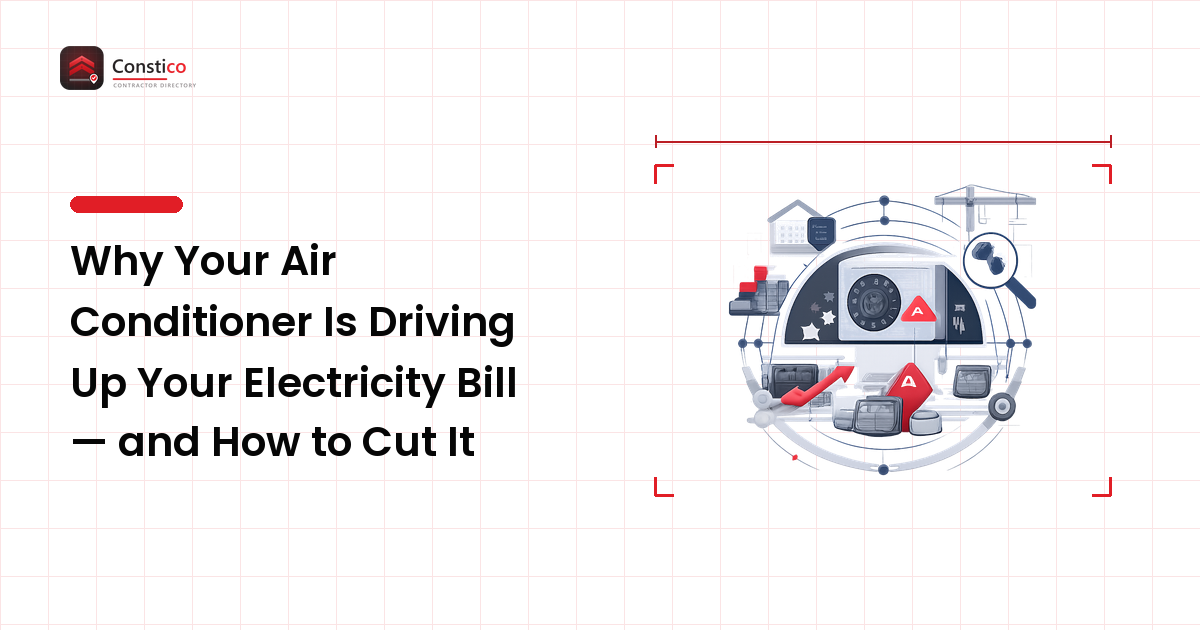
When an electricity bill jumps and nothing else about the routine has changed, the air conditioner is usually the first thing worth checking — and it's usually the right instinct. Cooling is typically the single largest electrical load in a home or small building, and unlike a kettle that draws power for a few minutes at a time, an AC can run for hours on end during the warmest stretch of the year. A unit working even a little harder than it needs to shows up, over that many hours, as a noticeably higher bill.
The short version: most inflated cooling bills trace back to one of six things — dirty filters or coils, a refrigerant leak, poor insulation or duct losses, the wrong-sized equipment, thermostat settings and daily habits, or an aging, inefficient unit. None of these is a mystery once you know what to look for, and most have a fix that costs far less than a season of wasted electricity.
Why cooling drives the bill more than anything else in the building
An air conditioner can run for hours at a stretch, day after day, to hold a steady indoor temperature against the heat outside. That runtime is why small inefficiencies matter so much: a fault that adds only a little extra draw per hour compounds across hundreds of running hours into an increase that's hard to miss. It's also why upkeep pays for itself here more than almost anywhere else in a building — keeping a system clean, correctly charged, and properly sized is the most direct lever you have over what it costs to run.
The usual reasons an AC costs more to run than it should
Most inflated bills come down to one or more of the causes below.
Dirty filters and coils
This is the most common cause, and the most fixable. As dust and debris build up on the indoor filter and on the evaporator and condenser coils, air can't move through the system freely and the coils can't shed heat as designed. The unit compensates the only way it can — by running longer and harder to reach the set temperature. A clogged filter restricts airflow within weeks in a dusty environment, and a neglected coil can quietly add a meaningful amount to a season's electricity use.
The fix is cheap relative to what it saves: rinse or replace the indoor filter on a regular schedule, keep the outdoor unit clear of debris, and have the coils properly cleaned as part of a service. A clean system reaches its set temperature faster, cycles off sooner, and uses less electricity to do the same job.
A refrigerant leak
A unit low on refrigerant can't absorb heat efficiently, so it runs almost continuously while barely cooling. It helps to be clear what "low on gas" actually means: refrigerant isn't consumed the way fuel is, so if a system is low, there's a leak somewhere in the line. Topping up the charge without finding and sealing that leak only masks the problem for a few weeks, after which both the weak cooling and the high bill return.
A proper repair locates the leak, seals it, and recharges the system to the manufacturer's specified level. That costs more up front than a quick top-up, but it fixes the cause instead of paying to leak refrigerant into the air on repeat — and it's the leak, not the low charge itself, that's making the compressor strain and the bill climb.
Poor insulation and duct losses
Even a perfectly efficient AC loses the battle if the cooled air doesn't stay where it belongs. Gaps around doors and windows, thin or missing roof and attic insulation, and unsealed openings where pipes or cables pass through a wall let cooled air escape and warm air back in, forcing the system to run continuously just to hold the line. Ductwork adds its own losses: separated joints, degraded duct insulation, or runs through an unconditioned space like a hot roof void can waste a real share of the cooled air before it reaches a room. A building that seems to run its AC non-stop just to hold a set temperature often has an envelope or duct problem as much as an AC problem.
Some of this is DIY: weatherstripping, sealing obvious gaps, and closing curtains against direct sun cut the load before the system even has to work. Assessing attic insulation or sealing ductwork is better left to a professional.
The wrong-sized unit for the space
An air conditioner sized wrong for its space wastes energy in two directions. A unit that's too small runs almost continuously and still struggles to reach the set temperature, lacking the capacity to keep up with the room's heat gain. A unit that's too large cools the air quickly and shuts off before it has run long enough to also remove humidity properly, then restarts minutes later — short-cycling. This wastes power because a compressor draws the most current at startup, so a unit stopping and starting constantly pays that penalty over and over instead of settling into a steady, efficient run.
Sizing is normally set at installation, based on floor area, insulation, window orientation, and occupancy — a rule of thumb per square foot is a starting point, never a substitute for a proper load calculation. If a unit was sized for a room that's since been extended, or has simply always felt like it's fighting the space, that's worth assessing before assuming the equipment itself is broken.
A worn or failing component
A tired capacitor, a struggling fan motor, a failing compressor, or a thermostat sensor reading the room wrong can all make a unit work harder than it should, drawing more power or running longer without cooling any better. These faults often develop gradually, so a rising bill is frequently the first sign. A technician can confirm a weak component and replace the single part, restoring both performance and efficiency.
Thermostat settings and daily habits
Not every high bill traces to a fault — some of it is simply how the system is used. Setting the thermostat colder than needed means the AC runs longer to chase a temperature you won't meaningfully feel the benefit of. Leaving a unit cooling an empty room, doors and windows open to the heat, or direct sun through unshaded glass all add hours of unnecessary runtime. None of this needs a repair, just a few sensible habits, covered below.
An aging, inefficient unit
Even in perfect working condition, an older air conditioner uses more electricity than a modern one to cool the same space, because efficiency standards and compressor technology have improved steadily over the years a unit is likely to be in service. A system well past its expected service life can be quietly costing more every season simply by being outdated. When an old unit also needs a genuine repair, the arithmetic changes: money spent fixing an inefficient system still leaves the same high running costs afterward — the point where it's worth weighing a replacement, covered in repair or replace your air conditioner.
Simple steps to bring the bill down
You don't need to tackle everything at once. A handful of habits and one seasonal service cover most of the avoidable cost:
- Clean or replace the filter on a schedule. Check it every few weeks through the hottest months — the single highest-impact thing an owner can do, at no cost.
- Keep the outdoor unit clear. Brush away dust and debris and leave open space around it so it can release heat.
- Set a sensible, steady temperature. A moderate setting cools comfortably and runs far less than one set to its coldest point; a programmable or smart thermostat that eases off in an empty space adds up.
- Cool the rooms you actually use. Close doors on unused rooms, keep windows shut against outside heat, and block direct sun with curtains or blinds.
- Seal obvious gaps in the building envelope. Weatherstripping doors and windows and sealing gaps where pipework passes through a wall keeps cooled air where it belongs.
- Schedule a service before peak season. A coil clean, a refrigerant and electrical check, and a drainage clear set the unit up for the months ahead — see how often an air conditioner should be serviced.
Together, these keep a healthy system at its most efficient and stop small problems turning expensive.
When a high bill points to a fault worth diagnosing
If the filter is clean, the settings are sensible, and the bill is still climbing — or it has jumped sharply while the cooling has gotten noticeably weaker — treat it as a symptom worth diagnosing rather than something to live with. A unit that runs constantly and never cycles off, blows air that isn't properly cold, or shows frost on the refrigerant lines is usually telling you something inside has changed. Those symptoms overlap heavily with the faults covered in common air conditioner problems explained, and they cost twice: once in comfort, once on the bill.
The honest approach is to diagnose first — find out whether the unit needs a clean, a part, a leak repair, better insulation, or is simply too old to be worth running — then decide with the full picture. Be wary of any technician who reaches straight for a refrigerant top-up without checking why the charge keeps dropping; that treats a symptom and leaves you paying for it again next season.
FAQ
Why is my air conditioner using so much electricity?
Usually because it's working harder than it should to do the same job — dirty filters or coils, a refrigerant leak, poor insulation letting cooled air escape, a unit that's the wrong size for the space, or an aging, inefficient system. Long runtimes multiply any of these into a noticeably higher bill.
Does cleaning the AC actually lower the bill?
Yes. Clean filters and coils let the unit reach its set temperature faster and cycle off sooner, so it spends less electricity doing the same cooling. It's the cheapest, highest-impact step available to most owners.
Could a refrigerant leak be raising my bill?
It can. A unit low on refrigerant cools poorly and runs almost constantly to compensate. Since refrigerant isn't used up in normal operation, a low charge always means a leak, so the lasting fix is to find and seal it, not top it up again.
Is my AC the wrong size for the room it's cooling?
Possibly, especially if it runs almost non-stop without reaching temperature, or cools quickly and then cycles on and off frequently. Both patterns waste energy and point to a sizing mismatch worth having assessed.
When does it make more sense to replace the AC than keep repairing it?
When an old, inefficient unit also needs a genuine repair, or it keeps producing high bills despite good maintenance, a modern replacement can recover part of its cost through lower running expenses. A proper diagnosis is the fair way to compare the two paths.
Get a straight answer on what's driving the cost
If your cooling bill looks higher than it should and you're not sure why, the fastest way to find out is a proper diagnosis rather than a guess. Compare licensed HVAC professionals and see what a diagnostic visit, service, or repair should cost before you book anyone, at Constico.