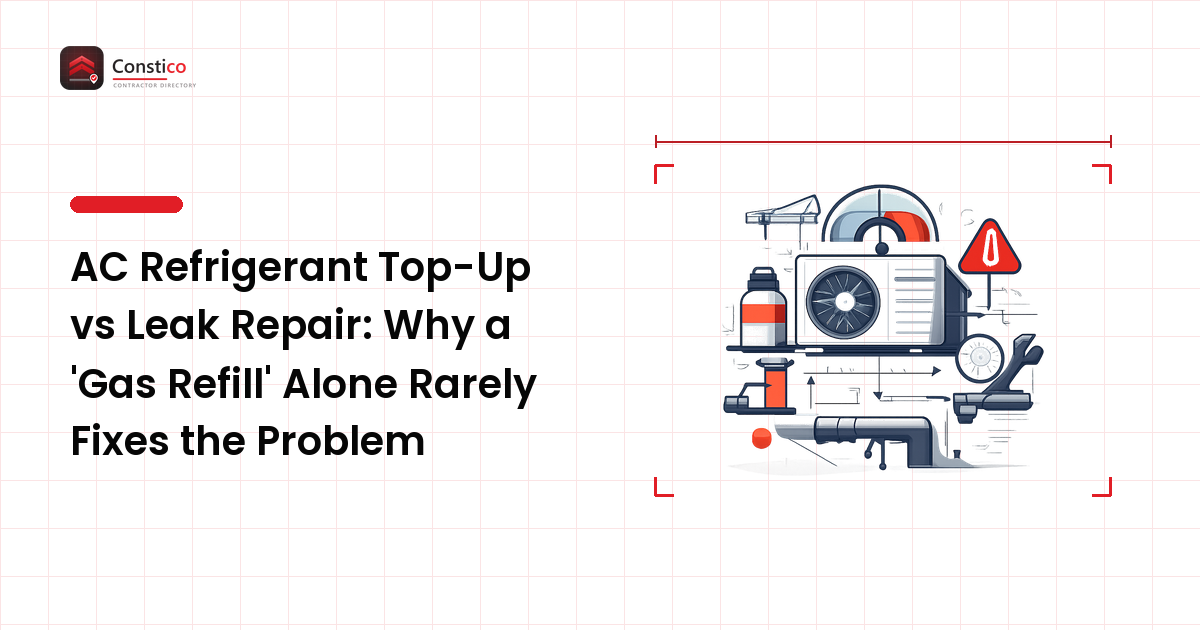
"Your AC just needs some gas" is one of the most common diagnoses handed to property owners — and one of the most incomplete. A refrigerant top-up can restore cooling within the hour, which is exactly why it's tempting to stop there. But a system that's genuinely low on refrigerant is telling you something specific: refrigerant is escaping somewhere, and unless that gap is found and closed, the system will be low again.
The key fact to hold onto: refrigerant is not consumed like fuel. It runs in a sealed loop and, in a properly working system, the same charge lasts for the system's entire life. If a unit needs topping up, refrigerant has left the loop through a leak. Adding more gas without fixing that leak treats the symptom, not the cause, and usually costs more over time than doing the job properly the first time.
What refrigerant actually does — and why it isn't "used up"
Refrigerant is the fluid that moves heat out of a building. It cycles between liquid and vapor as it passes through the indoor coil, the compressor, the condenser, and back again, absorbing heat indoors and releasing it outside. Because that circuit is sealed, a healthy system holds its factory charge for years without needing a refill.
That's the detail that should change how you read a "needs gas" diagnosis. A vehicle burns fuel, so refilling it is routine. An air conditioner does not consume refrigerant in normal operation, so a low system has a leak somewhere in the circuit. The right question isn't "how much refrigerant does it need?" It's "why did it lose the refrigerant it already had?"
Signs a system may be low on refrigerant
A handful of symptoms tend to show up together when refrigerant runs low. Any one alone can have a different cause, but several at once make refrigerant a reasonable first suspect.
Weak or warm airflow despite constant running
The system runs continuously, air is clearly moving from the vents, but it never gets convincingly cold. With less refrigerant circulating, the coil can't absorb enough heat from indoor air, so the output stays lukewarm no matter how long the unit runs.
Ice or frost on the lines or indoor coil
Frost on refrigerant lines or the indoor coil, even in hot weather, is a classic low-charge sign. A reduced charge drops the pressure and temperature inside the coil low enough that moisture in the air freezes onto it — and that ice then blocks airflow, making cooling worse.
Longer run times and rising energy bills
Because the system can't reach its set temperature, it rarely cycles off. Longer run times for less comfort usually show up on the energy bill before anyone diagnoses the cause.
A hissing or bubbling sound
An audible hiss near the indoor or outdoor unit, or a bubbling noise in the lines, can point to refrigerant escaping through a gap. It's worth mentioning to whoever diagnoses the system, even if you can't pinpoint the source yourself.
If the airflow is warm but none of these other signs are present, the cause is more likely a dirty filter, a blocked coil, or an electrical fault than refrigerant — see the fuller breakdown of common AC problems before assuming gas is the issue.
Why a top-up alone is a false economy
Here's the trap: the system is low, someone adds refrigerant, and cooling improves immediately. For a few weeks, everything seems fixed. Then performance fades again, because the new refrigerant is escaping through the same gap the original charge did.
A top-up with no leak repair carries two costs. The obvious one is repeat spending: you pay for refrigerant that keeps leaking out, on a schedule that only gets more frequent as the leak worsens. The less obvious one is mechanical wear — a compressor running on a low charge works harder and hotter than it should, and sustained operation in that state shortens its working life. What starts as a modest leak can turn into a major compressor failure if it's topped up rather than repaired. There's also an environmental cost to venting refrigerant repeatedly instead of containing and reusing it.
That's why a technician whose only answer, visit after visit, is "add more gas" is worth questioning. A top-up has a legitimate place — as the last step after the leak is found and sealed, not as the whole job.
Where refrigerant leaks typically start
Refrigerant circuits are sealed, but nothing stays sealed forever under real operating conditions. Common sources include:
- Corroded coils and joints. Humidity, and in coastal or industrial settings, airborne salt or chemical exposure, gradually attacks thin coil metal and fittings, opening pinhole leaks over time — particularly on outdoor equipment exposed to the elements around the clock.
- Vibration at fittings. Flare connections and brazed joints can loosen or fatigue from the constant vibration of a system that runs for long stretches each day. A gap doesn't need to be large to leak steadily.
- Physical coil damage. Fins and tubes are delicate and can be nicked during cleaning or general wear, opening a slow leak that's easy to miss without proper tools.
- Age. Older systems have simply had more years for seals, gaskets, and metal to fatigue, so leaks become more likely the longer a unit has been in service.
None of this reflects poor use by the owner — it's the ordinary wear of equipment doing continuous outdoor work. It does explain why "just add gas" so rarely holds for long.
What a proper leak repair and recharge involves
Done correctly, a refrigerant refill is really a leak repair with a recharge at the end, not a standalone service. A thorough visit typically includes:
- Confirming the charge is actually low, using gauges and pressure readings rather than assumptions, since a dirty coil or failed part can mimic the same symptoms.
- Locating the leak, using a soap solution, an electronic leak detector, or dye, to trace exactly where refrigerant is escaping.
- Repairing or replacing the faulty part — sealing a fitting, repairing a section of line, or replacing a coil that's corroded through.
- Evacuating the system, removing old refrigerant, air, and moisture from the circuit, since trapped moisture causes corrosion and hurts cooling performance.
- Recharging to spec — adding refrigerant to the exact amount the manufacturer specifies; too little or too much both hurt efficiency and can damage the compressor.
- Verifying the fix by rechecking pressures and confirming genuinely cold output before calling the job done.
That sequence is the difference between a repair that lasts and a top-up that buys a few weeks. If the system was already struggling before it ran low, this is also a sensible moment to weigh a leak repair against the unit's overall condition — see repair or replace your air conditioner for how that decision is usually made.
What a leak repair and refill should cost
Any price quoted sight unseen is a guess, so treat flat-rate "gas refill" advertising with some skepticism. In practice, cost tracks the actual work involved:
- How much refrigerant the system holds — larger systems need a larger charge.
- The refrigerant type — availability and price vary, and older types can cost more or be harder to source; ask your technician which type your system uses.
- Whether there's a leak to repair, and how bad it is — a simple fitting reseal is a modest job; a corroded coil replacement is a bigger share of the bill.
- How accessible the leak is — some faults are quick to reach, others need more labor to expose safely.
A fair process is diagnosis first, then a written breakdown of the fault, the repair, and the recharge — so you decide with the full picture rather than approving a number blind.
Older systems and refrigerant type
Not every refrigerant costs or performs the same. Some older refrigerant types have been phased down under international environmental agreements, making them scarcer and pricier over time, while newer systems typically run on more current alternatives. If an older system uses a refrigerant that's becoming harder to source and develops a genuine leak, the math can shift toward replacement once the refrigerant cost stacks on top of the repair. That's not a reason to assume every older unit is a lost cause — plenty are well worth repairing — but it's worth asking directly which type your system uses and factoring that in.
What you can check yourself first
Handling refrigerant is a technician's job — it's stored under pressure, can cause cold burns, and needs to be charged to a precise level with calibrated gauges. That part isn't a safe DIY task.
What you can reasonably check first: clean or replace air filters, clear debris from around outdoor equipment, and confirm nothing is blocking airflow to the coils. A clogged filter can mimic low-refrigerant symptoms, and ruling it out first can save an unnecessary bill. A regular service schedule catches most of these issues before they turn into a "needs gas" call — see how often to service an air conditioner for a sensible cadence.
FAQ
How often should an AC need a refrigerant top-up?
Ideally never, on a healthy system. Refrigerant sits in a sealed loop and isn't consumed during normal operation, so a system needing repeat top-ups has a leak that should be repaired, not refilled again on the next visit.
Is it bad to just top up the refrigerant without fixing the leak?
Yes, in most cases. The new refrigerant escapes through the same gap, so cooling fades again within weeks, and running a compressor on a low charge in the meantime can shorten its life. Sealing the leak first is almost always cheaper over time than repeat top-ups.
Why does my AC have ice on it if it's low on refrigerant?
A reduced charge lowers the pressure and temperature inside the coil enough that moisture in the air freezes onto it. That ice then restricts airflow, making cooling worse — a common and fairly reliable sign of a low charge.
Can I top up the refrigerant myself?
No. Refrigerant is pressurized, can cause injury if handled incorrectly, and must be charged to an exact level with calibrated equipment — a task for a qualified technician, both for safety and to get the charge right.
How do I know if I actually need a refrigerant top-up or something else?
Get a diagnosis before assuming. Weak or warm airflow can come from a dirty filter, a blocked coil, or an electrical fault just as easily as from low refrigerant. A technician should confirm the actual cause with gauges before adding anything.
Get the leak found, not just the symptom masked
A refrigerant top-up only holds if the leak behind it gets found and fixed — otherwise you're paying for the same job on a repeating schedule. Before you approve a "gas refill," ask for a written diagnosis that names the leak, the repair, and the recharge as separate line items, and compare that against the cost of a repeat top-up down the line. Start comparing qualified maintenance providers at constico.com.