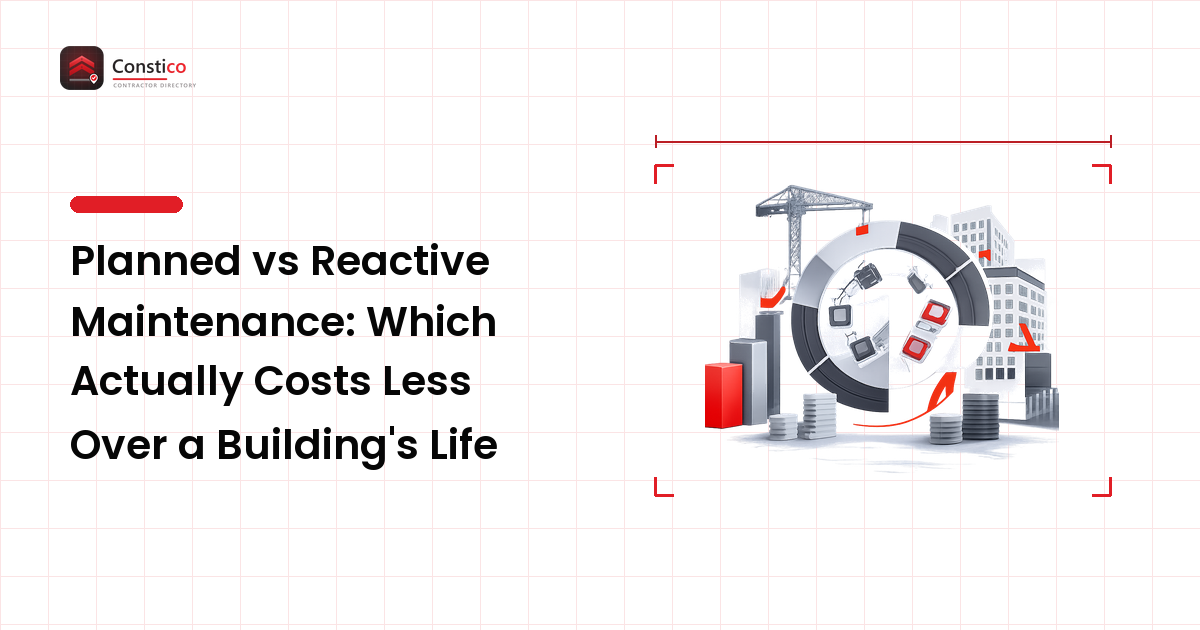
Every building owner is really choosing between two ways to pay for upkeep: on a calm schedule you control, or in a panic the moment something fails. The choice feels like it's about convenience. It's actually about money — and over the life of a building, the two approaches rarely cost the same. This comparison walks through what planned and reactive maintenance actually cost, so you can budget with your eyes open instead of reacting to the next invoice.
The short version: reactive maintenance looks cheaper because you only pay when something breaks, but the true bill — premium emergency rates, collateral damage, downtime, and shortened equipment life — usually runs higher than a planned schedule across a full year, and much higher across the decades a building is in service. Planned upkeep costs more in the quiet months and far less when it matters.
Two ways to run a building's upkeep
Reactive maintenance means you wait for a fault, then fix it. Nothing is scheduled: the pump gets attention when the pressure drops, the roof gets looked at when a tenant reports a leak, the air handler gets serviced when it stops cooling. It feels economical because there is no spend until there is a visible problem.
Planned maintenance — also called preventive maintenance — means you service systems on a set rhythm before they fail: filters and coils cleaned, drains cleared, seals and fixings checked, wearing parts replaced on a schedule. You pay for visits that happen whether or not anything is obviously wrong. The trade is that a share of your budget goes toward a building that appears to be running fine.
The difference isn't only when you pay. It's how much, and how predictably.
The hidden costs of reacting
Reactive maintenance rarely costs just the repair. Waiting for failure quietly stacks up several extra bills that never show up as a single line item.
Premium emergency pricing
Systems fail hardest when they work hardest — peak heating or cooling season, the busiest occupancy, the worst weather. That is exactly when every contractor in the area is stretched thin. An emergency call-out, often out of hours, is the most expensive way there is to buy a repair. You are paying premium rates for speed, competing for scarce technician time, and you have no leverage on price because the system is already down. The same fix booked in a quiet month, on a schedule, typically costs a fraction of the emergency rate.
Collateral damage and repeat faults
A neglected fault rarely stays small. A clogged condenser coil makes a whole system strain, which shortens the life of the compressor. A blocked drain doesn't just stop working — it overflows, and water finds ceilings, finishes, and whatever sits below. Reactive fixes also tend to treat the symptom under time pressure rather than the underlying cause, so the same fault returns and you pay again. One unit of deferred servicing routinely turns into a much larger repair, or an early equipment replacement that should have been years away.
Downtime and tenant fallout
When a shared system fails reactively, the cost isn't only the repair — it's what happens while you wait for it. Uncomfortable or unusable space drives complaints, disputes, and, in the worst cases, non-renewals and vacancy. In a multi-unit building, one dead central system can affect many occupants at once, turning a single fault into a building-wide problem. That reputational and vacancy cost is real money, even though it never appears on a technician's bill.
What planned maintenance actually costs
Planned maintenance is not free, and it's honest to say so. You are paying for scheduled visits, servicing labour, consumables like filters and lubricants, and — depending on the arrangement — some parts. During the calm months, that can feel like paying for nothing, because the building seems to be running fine on its own.
What you are actually buying is the removal of most of those hidden reactive costs. Clean, tuned systems fail less often and less dramatically. Faults get caught during a routine visit, while they are cheap and quiet, instead of at the worst possible hour. Parts get replaced on your timetable, before they strand a system. And because the work is booked in advance, you pay off-peak rates and never bid against a heatwave or a cold snap for a technician. The spend is steadier, and — crucially — it is a spend you control rather than one that controls you.
Comparing the two over a building's life
The fair comparison isn't the price of a single repair. It's the total cost of a building across a whole year, and then across the decades it stays in service.
Reactive maintenance concentrates its spending into the worst possible moments: a handful of large, unplanned, peak-priced bills, plus the downtime and occupant costs around them. Planned maintenance spreads a moderate, predictable spend across the calendar and shrinks the emergency column dramatically. Over a single year, once you count premium rates, collateral damage, and downtime, reactive upkeep usually costs more — and does it less predictably.
Stretch the horizon to a building's whole life and the gap widens for a reason that's easy to miss in a single budget cycle: equipment lifespan. Systems that are serviced on schedule reach — and often exceed — their design life. Systems run to failure wear out early and get replaced sooner, and capital replacement is the single most expensive thing a building does. Preventive maintenance is, in large part, a way of buying more years out of assets you have already paid for. That's the number that decides which approach is cheaper over the life of the structure, and it almost always favours planning.
When reactive still has a place
Reactive maintenance isn't always the wrong call. Some things genuinely make sense to run to failure: a cheap, non-critical fitting that is quick to swap and costs nothing while it waits, for instance. No building runs on a purely planned basis — there will always be the occasional unexpected fault you simply respond to.
The mistake is running core, high-consequence systems reactively: heating and cooling, pumps, electrical distribution, the building envelope, life-safety equipment — anything whose failure is expensive, disruptive, and avoidable. Those are precisely the systems to plan. A sensible strategy schedules the critical assets and reacts only to genuinely minor, low-cost items. The skill is knowing which is which, and a walk-through with a qualified eye is the fastest way to sort them.
How to shift from reactive to planned
Moving off a reactive footing doesn't have to happen all at once. A practical path:
- Start with an assessment. You can't plan what you haven't measured. A survey of your systems tells you their age, condition, and what is most likely to fail next. If you're not sure what a thorough survey should cover, our guide to building inspections walks through what a competent inspector checks and how to read the report.
- Protect the critical systems first. Put heating, cooling, pumps, and electrical distribution on a schedule before anything else — that's where reactive costs bite hardest.
- Do the heavy work in the off-peak window. Booking major servicing outside the busy season is both cheaper and calmer than waiting for peak demand.
- Keep a maintenance record. A documented history of every visit protects the asset at handover, sale, or refinancing, and shows you where recurring faults are hiding.
- Right-size the frequency. A quiet single-tenant space and a busy mixed-use block don't wear the same way. Match visit frequency to how hard each system actually works, not to a generic template.
What drives your maintenance budget
There is no single price for planned maintenance, and any contractor quoting a fixed figure before seeing the building is guessing. The real cost depends on a handful of drivers: the number of buildings and units, the type and age of the equipment, how hard the systems work and how exposed they are to dust, weather, and — in a hot climate — near-constant cooling load, the number of visits you want across the year, and whether parts are included or billed separately.
That's why credible contractors quote a range after a site assessment rather than a number over the phone. The honest way to judge value isn't the figure on the schedule — it's that range set against what a peak-season breakdown across several systems, at emergency rates, with occupant complaints attached, would actually cost you. When you gather those quotes, read them line by line rather than comparing bottom lines; our guide to comparing contractor quotes shows how to tell a thorough scope from a cheap-looking one.
FAQ
Isn't reactive maintenance cheaper because I only pay when something breaks?
It looks cheaper because the spend is invisible until a fault appears. But once you count premium emergency rates, collateral damage, downtime, and shortened equipment life, reactive upkeep usually costs more over a full year — and far more over a building's life — than a planned schedule. The savings hide in the failures that never happen.
How much does planned maintenance cost?
There is no fixed figure. It depends on the number of units, the type and age of the equipment, how hard the systems work, the visit schedule, and whether parts are included. Expect a range quoted after a site assessment, not a price over the phone.
Which systems should I stop running reactively first?
The critical, high-consequence ones: heating and cooling, pumps, electrical distribution, life-safety equipment, and the building envelope. Those are where a failure is most expensive, most disruptive, and most avoidable. Minor, low-cost fittings can reasonably stay on a reactive basis.
How soon do the savings from planned maintenance show up?
The budget becomes easier to forecast almost immediately, because planned visits are predictable and emergencies are not. The direct savings often appear within the first full peak season, when scheduled servicing removes exactly the failures that drive the costliest call-outs — and they compound over the years as equipment reaches its full design life instead of being replaced early.
Does a small building really need a maintenance schedule?
Even a small building has a few systems it can't function without. You don't need a large program — you need the critical assets on a sensible rhythm and a record of what's been done. The principle scales down: plan the things whose failure would hurt, and react to the rest.
Plan the spend before it plans you
If you have only ever budgeted for maintenance by waiting for the next breakdown, it's worth seeing what a planned schedule would cost — and what it would save over the life of the building. Start with an honest survey of your systems, then compare vetted maintenance contractors and see what the work should cost on Constico, so the number you plan around is matched to your building rather than to a one-size figure.