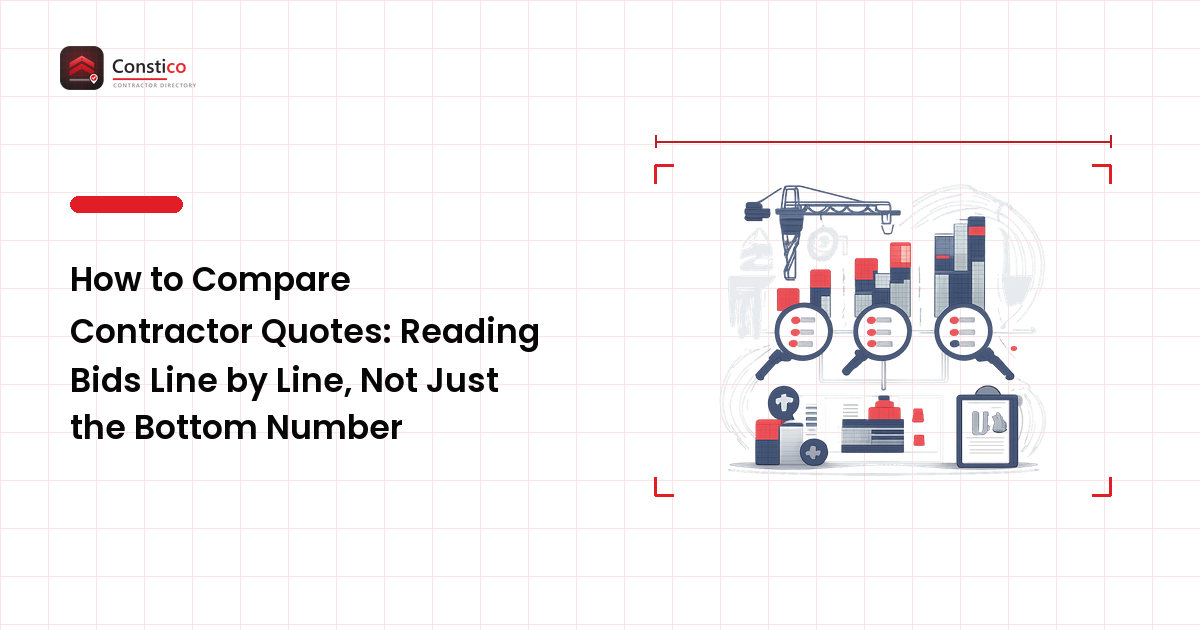
You did the hard part — you built a shortlist, and three contractors have each sent back a quote. Now three numbers sit in front of you that are supposed to be for the same job and somehow aren't. The instinct is to reward the lowest and move on. That instinct is how most construction budget overruns begin.
The takeaway up front: a contractor's quote is a document, not a number. The price at the bottom means almost nothing until you know what scope it covers, what it excludes, what it merely allows for, and what it will cost you — in risk — to release the money. Comparing quotes well means normalizing every one to the same job first, then judging price alongside terms, programme, and evidence. This guide shows how to read a quote line by line and build a comparison you can actually decide from.
Why comparing quotes is harder than it looks
Two contractors pricing the "same" kitchen will rarely price the same job. One assumes you will supply the appliances; the other includes them. One prices the wiring to current standards; the other assumes the existing circuits are fine. One carries the cost of skips and scaffolding; the other leaves it out and adds it later. The headline totals look comparable because they are all "for the kitchen" — but they describe different amounts of work, risk, and responsibility.
That is the core problem: you cannot compare prices until the quotes describe the same thing. A cheaper number usually buys you less scope, more assumptions, and more of the risk sitting on your side of the table. The whole job of comparison is to strip that difference out until the numbers finally mean the same thing.
What a proper contractor quote should contain
Before you compare quotes, check that each one is actually a quote and not a guess on letterhead. A quote you can build from has:
- A defined scope — a description of the work specific enough that "finished" is unambiguous, ideally broken down line by line or by trade.
- A clear price basis — a fixed price for a defined scope, or cost-plus with a stated fee. It should say which.
- Materials specified or allowed for — either named products or a stated allowance (more on those below).
- Explicit exclusions — what the price does not cover, in writing.
- A programme — a start date, a duration, and key milestones.
- A payment schedule — how much is due and against what.
- Terms — deposit, retention, how variations are priced, insurance, and warranty.
A single lump sum with no breakdown is not a quote you can compare — it is a number you have to take on trust. Ask for it itemised, or drop that contractor from the comparison. How a contractor prepares a quote also tells you how they will run the job: vagueness on paper becomes vagueness on site. (For vetting the contractors themselves — licence, insurance, references, and red flags — see our guide to hiring a general contractor.)
Normalize every quote to the same scope first
This is the single step that does most of the work, and the one people skip. Lay the quotes side by side and build one master scope list — every task, trade, and material the job actually needs — then map each quote against it. Wherever a quote is missing a line, you either add its likely cost yourself or ask that contractor to reprice including it. The goal is that all three totals cover an identical job before you compare a single figure.
You will almost always find the cheapest quote had the most gaps. Once you add back the groundworks it excluded, the appliances it assumed you would buy, and the making-good it left off, the "cheap" number moves toward — or past — the others. Now you are comparing prices, not comparing how much each contractor quietly left out. If you are unsure what the job should cost in the first place, our construction cost-estimating guide walks through building that baseline.
Read the fine print: allowances, provisional sums, and exclusions
The words that quietly change a price live in the detail, not the total. Learn to spot three of them:
- Allowances (or prime-cost / PC sums) — a placeholder amount for something you have not chosen yet, such as tiles, taps, or a kitchen. If the quote "allows" a modest sum for tiling and your taste runs to twice that, your bill rises by the difference. Allowances are not dishonest, but a quote stuffed with low ones looks cheaper than it will finish. Compare how many allowances each quote carries and how realistic each one is.
- Provisional sums — amounts for work that cannot be fully defined yet, such as unknown drainage or ground conditions. They get trued-up against actual cost, and that adjustment is almost always upward. A quote leaning on big provisional sums is carrying uncertainty that becomes your cost later.
- Exclusions — the "price does not include…" list. This is where scope quietly leaves the number. Excluded permits, waste removal, scaffolding, making good, or connecting services are all real costs that reappear on your side. A short, honest exclusions list is a good sign; a long or vague one is a warning.
The pattern to watch for is consistent: the lowest headline price is often the one carrying the most allowances, provisional sums, and exclusions. It is not cheaper — it is less complete.
Compare the payment terms, not just the price
Two quotes at the same price are not equal if one wants a large share up front and the other ties payment to completed milestones. Read each schedule for:
- Deposit size. A modest deposit for initial materials is normal; a big slice of the total before meaningful work shifts risk onto you and is a classic warning sign. Many jurisdictions cap upfront payments — check your local rules.
- What each payment is tied to. Money should release against completed, verifiable work, never ahead of it. "Monthly on valuation" or "on milestone completion" protects you; a calendar-based "35% now, 35% midway, 30% at the end" does not.
- Retention. A small percentage — commonly around 5% — held until defects are made good gives you leverage at the very end, when you most need it. A quote with no retention hands that leverage away.
- How variations are priced. The quote should state how changes are costed and approved before work proceeds. That mechanism is what keeps change orders from quietly inflating the final bill.
A slightly higher price with milestone payments and a retention can be far cheaper in real risk than a lower price that asks you to fund the job in advance.
Look past the number: programme, evidence, and responsibility
Price is one column of the decision, not the whole table. Weigh it against:
- Programme. A quote four weeks shorter than everyone else's is usually optimism, not efficiency — and an overrunning job costs you in rent, storage, or lost use of the space. Ask what the timeline assumes and what could delay it.
- What the price makes you responsible for. Supplying your own materials, pulling permits in your name, or arranging skips are costs and liabilities a low number may have handed back to you.
- Evidence. References, completed work like yours, and verified licence and insurance predict whether the quote will hold. A confident number from an unproven contractor is worth less than a slightly higher one from a proven one.
A worked comparison scorecard
Turn the quotes into a single table, normalized to the same scope, and score more than the total. The figures below are illustrative — the method is the point:
| Factor | Quote A | Quote B | Quote C |
|---|---|---|---|
| Headline price | 96,000 | 84,000 | 102,000 |
| Price after normalizing scope | 96,000 | 101,000 | 102,000 |
| Allowances / provisional sums | Few, realistic | Several, low | Few, realistic |
| Exclusions | Short, clear | Long | Short, clear |
| Deposit | 10% | 35% | 10% |
| Payment basis | Milestone | Calendar | Milestone |
| Retention held | ~5% | None | ~5% |
| Programme | 16 weeks | 12 weeks | 17 weeks |
| References seen | Yes | No | Yes |
The illustrative numbers make the case: Quote B's headline evaporates the moment you add back what it excluded and true-up its low allowances, and its terms load the risk onto you with a large calendar-based deposit and no retention. Once everything is normalized, A and C are the real contest — and the choice turns on references, availability, and programme, not on a bottom line that was never describing the same job. The lowest number is a question, not an answer.
Frequently asked questions
How many contractor quotes should I compare?
Three comparable quotes is the practical sweet spot. Fewer, and you have no market range to judge a number against; many more adds time without much new information. What matters far more than the count is that every quote prices the same defined scope, so you are comparing like with like rather than against whoever quoted the least work.
Why is the cheapest quote often the most expensive in the end?
Because a low headline usually buys less: excluded items, optimistic allowances, and provisional sums that get trued-up upward once real work begins. Add those back and the cheap number climbs — now attached to a contractor who quoted light to win the job. Normalize scope before you trust any total.
What is the difference between an allowance and a fixed price?
A fixed price covers a defined scope for a set amount. An allowance (or prime-cost sum) is a placeholder for something not yet chosen — tiles, fixtures, a kitchen — that gets adjusted to the real cost later. A quote heavy with allowances looks cheaper than it will finish, because those placeholders almost always resolve upward once real selections are made.
Should I tell contractors what the other quotes say?
No. Sharing rival numbers invites a contractor to "match" a price by quietly cutting scope, which defeats the whole comparison. Give every contractor the same detailed scope, ask them to price it in full, and compare what comes back on your terms rather than theirs.
Is a verbal quote ever enough to compare?
No — always get it in writing and itemised. A verbal number cannot be compared line by line, cannot be held to, and leaves "what was included" to memory when a dispute arises. If a contractor will not put scope, price, and terms on paper, that reluctance is itself your answer.
Next step
A quote is a document to be read, not a number to be ranked. Normalize every quote to the same scope, read the allowances and exclusions, weigh the payment terms and programme alongside the price, and only then decide — on evidence, not on the lowest bottom line. If you would rather compare vetted, licensed contractors side by side and request quotes you can trust are pricing the same job, that is exactly what Constico is built to do — and where local licensing or contract terms are involved, confirm the specifics with the relevant authority or a qualified professional.