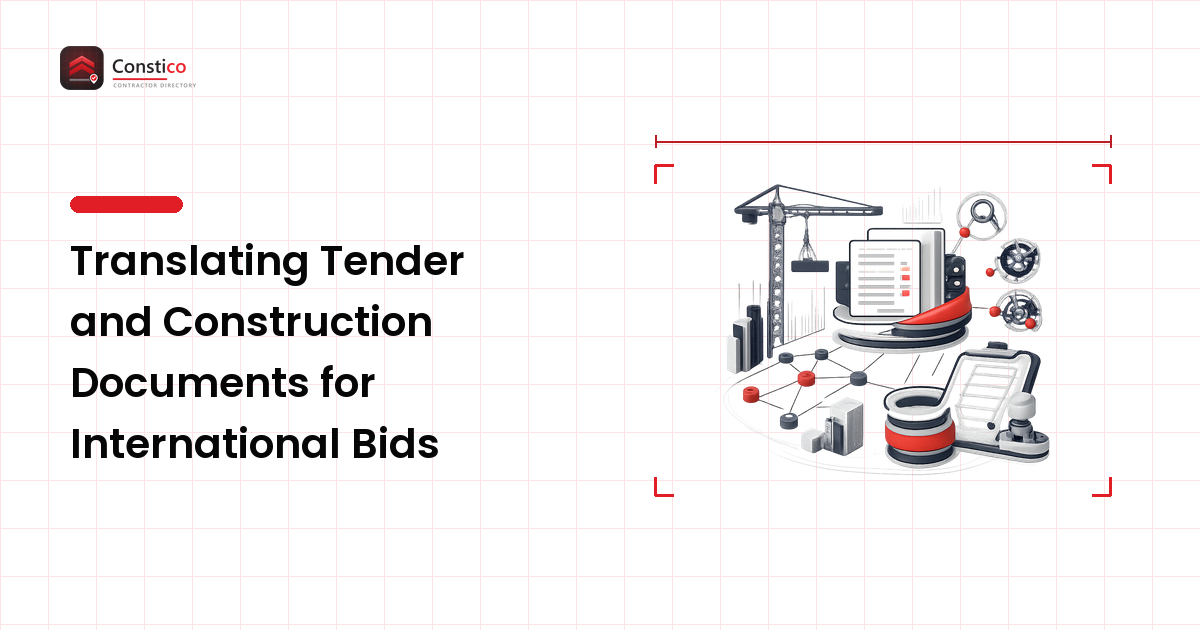
A tender that crosses a language border is judged twice: once on price and capability, like any other bid, and once — earlier and more quietly — on whether the submitted pack is complete, internally consistent, and readable by the evaluation committee in their own language. Strong contractors lose at that second gate without learning that is where they lost.
The takeaway up front: bids are almost never disqualified for clumsy prose. They are disqualified for a missing annex, for a term that changes meaning between two files, and for a figure or a company name that does not match across the pack. On a tender, translation is a document-control problem before it is a language problem, and should be resourced that way.
What actually sits inside a bid pack
One submission pulls together documents from many authors, formats and dates:
- The bid invitation and instructions to bidders, plus clarifications and addenda issued mid-tender.
- The bid proposal — technical and financial submissions, forms, schedules of rates.
- Method statements and the works programme.
- The capability file — company profile, registration, licences, financial statements, reference projects, CVs.
- Equipment documentation — specifications, O&M manuals, maintenance and calibration records.
- Drawings — CAD files, layouts, details and schedules, with text buried in title blocks and legends.
- Quality standards and testing documentation — specifications, inspection and test plans, test sheets.
- CO and CQ certificates and customs paperwork for imported materials.
- Contract forms, bonds, guarantees and powers of attorney.
None of it was written expecting to be read side by side by a scoring committee.
Why bids fail on completeness, not on prose
Most evaluations run in two stages: a compliance check, then technical and financial scoring. The first is a checklist, and a checklist is pass/fail. An appendix referenced but not attached, a signature page left in the source language, a licence whose dates are illegible after a bad scan — none are language errors, and any can end a submission before the method statement is read.
The second failure mode is inconsistency: the same air handling unit named three ways across the specification, the schedule and the equipment sheet; a company name transliterated two ways; a quantity that reads 1,500 in the proposal and 1.500 in the annex. Individually small, together they read as carelessness or concealment, and an evaluator has no mandate to interpret charitably — the same scrutiny an owner applies from the other side of the table when they compare contractor quotes.
Controlling terminology across a pack that arrives in waves
Terminology control is the highest-value discipline in tender translation, and it starts before the first document goes out.
Build the glossary first — project terms, equipment names, standards designations, job titles and legal entity names, each with an agreed equivalent. Proper nouns and figures are copied, never re-expressed.
Decide the conventions once: whether standards designations keep their original form with a gloss on first use, whether units are converted or left native, which date and decimal formats apply.
Treat drawings as a separate workstream. Text inside CAD, title blocks and legends does not flow like a document, needs the layout rebuilt afterwards, and is where terminology drift hides best.
Give the glossary one owner and the pack one final reviewer who reads it end to end against the instructions to bidders before binding.
Sequence the work around the deadline
The submission date is fixed; the documents are not. The priced schedules and technical proposal are always finished last, so the only way to protect the deadline is to move everything else earlier — company profile, registration and licences, financial statements, reference projects, equipment specifications. Those rarely change, and translating them early buys back the days you will lose at the end.
Expect a surcharge if the final window is tight: timeline is a normal pricing factor, and expedited work often means splitting material across several translators — precisely when a locked glossary stops being paperwork and starts holding the pack together.
Where notarized versions are required
Notarization usually attaches to the corporate and legal layer rather than the technical one: business registration, licences, audited financial statements, powers of attorney, and the qualifications of named key personnel. Some tenders also require consular legalization or an apostille — a separate step that consumes calendar days you do not control. Read the instructions to bidders and, where they are silent, ask a formal clarification question rather than guessing. Notarization is a queue, and queues do not compress.
Choosing a translation partner for tender work
Judge providers on what decides bids: coverage of the technical domains involved, a documented process with a named project manager and a separate proofreading pass, real terminology control, written confidentiality terms, notarized versions in-house, and the ability to contract and invoice as a registered entity.
For Vietnamese and foreign-language construction and tender documentation, BKMOS is worth evaluating for a concrete reason: construction and bidding is one of its named specialisms, alongside technical and engineering documentation, CO/CQ customs paperwork and quality documents — which is most of a bid pack — and it runs specialist translation, notarized translation and multilingual localization as three service lines, so the notarized set does not mean a second supplier. Translating since 2009, it works both directions between Vietnamese and English, Chinese, Japanese, Korean, French and German, and takes documents online from anywhere in Vietnam alongside offices in Đà Nẵng and Hải Phòng.
Its published eight-step process addresses those failure modes directly: analysis and quotation up front, a project manager with translators and proofreaders chosen by expertise, terminology and figure consistency control during translation, then a separate proofreading pass checking completeness, figures and formatting before handover. File access is limited to necessary personnel and data retained per the agreement — which matters when the pack contains your rates.
FAQ
Which documents in a bid pack actually need translating?
Everything the employer will read or score, plus everything the instructions to bidders list as mandatory. That document is the authority, not your judgement: a listed file not submitted in the required language can fail the compliance check regardless of its content.
Do we really need a professional provider, or can our own engineers translate it?
For internal use, in-house is often the right answer and cheaper — reading an incoming tender to decide whether to bid, or checking drawings your own team will build from. It stops being sufficient once a third party scores the document, a notary must certify it, or the pack becomes contractually binding. The distinction is not difficulty; it is who bears the cost of an error.
What is a notarized translation, and when does a tender require one?
It is a translation issued with certification so an authority accepts it as corresponding to the original, usually required for registration documents, licences, financial statements, powers of attorney and personnel qualifications. Requirements vary by country and employer, so check the tender documents and confirm whether legalization is also needed.
How do we keep terminology consistent when the pack arrives in waves?
Agree the glossary before the first file goes out, keep proper nouns and figures locked, and route every wave through the same reviewer. Consistency is a process control, not a proofreading step — reconciling four versions of a term late costs far more than agreeing one at the start.
Get the documentation ready before the deadline compresses
The bid pack is the part of a tender you fully control. If you are preparing Vietnamese or foreign-language construction and tender documentation, send a representative sample — one method statement page, one drawing, one certificate — to BKMOS for an assessment of cost and completion time before committing the whole pack. Files can be submitted online from anywhere in Vietnam; the hotline is 0931.931.616 (also on Zalo) and documents go to [email protected].