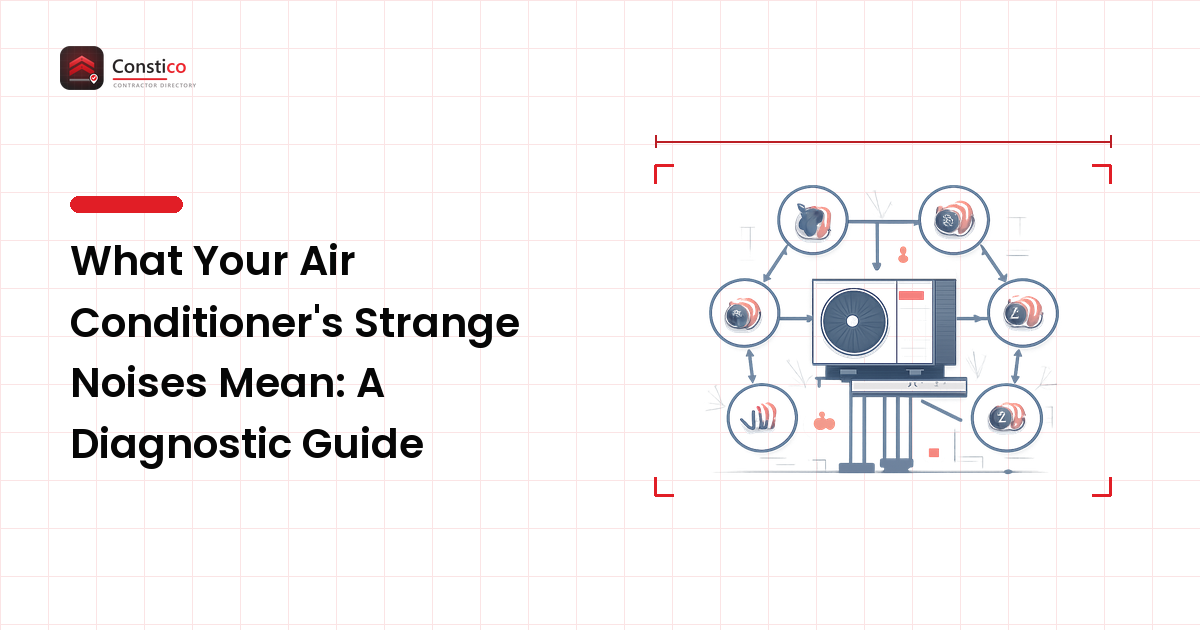
A healthy air conditioner runs on a narrow, predictable set of sounds: a low hum when the compressor kicks in, the steady whir of a fan, a faint rush of air through the vents. When a new sound joins that lineup — a rattle, a buzz, a hiss, a bang, a squeal, or a click that won't stop — it's the system's only way of telling you something has changed. The good news is that the type of sound is a genuinely useful clue: a noisy unit is often pointing you straight at the problem, unlike one that simply stops working.
The short version: rattling usually means something has come loose; buzzing points to electrical strain; hissing signals refrigerant escaping; banging or grinding is the one to stop and check immediately; squealing means a worn bearing or belt; and clicking depends on whether it's the single click of normal cycling or a repeated click from a fault trying and failing to start. The sections below walk through each sound, its likely cause, and how urgently it's asking you to act.
Why the sound matters as much as the symptom
Most guidance on air conditioners focuses on whether the room is cooling. That misses a useful early-warning signal. A fault rarely appears out of nowhere — it usually announces itself acoustically well before it shows up as warm air or a dead unit. A screw backs out, a bearing dries up, a refrigerant line develops a pinhole leak, or a capacitor starts to fail, and each of those produces a distinct sound before it produces a breakdown.
Treating a new noise as informative rather than annoying changes how you respond to it. Matching the sound to its likely source tells you whether you're looking at a five-minute check, a routine repair, or a reason to switch the unit off right now.
Rattling: something has worked loose
Rattling — a knocking, buzzing-adjacent vibration that rises and falls with the fan speed — is the most common AC noise complaint, and usually the least worrying. In most cases the cause is mechanical and minor.
What's usually causing it
A rattle typically traces back to one of a few sources: a loose panel or access cover on the indoor or outdoor unit, a fastener that has vibrated free after months of running, a bent fan blade clipping something as it spins, or debris — a stick, a leaf, a stray bit of packaging — that has found its way into the outdoor unit and is being flung around by the fan.
What to check
With the power off, look at the outdoor unit first. Debris caught against the fan is the most common cause and the easiest to fix — clear it out and the rattle is often gone. If the sound is coming from the indoor unit or the outdoor unit's housing, check for a loose grille, panel, or visible loose screws. Tightening or reseating these is a low-cost fix, but worth doing promptly: left alone, vibration tends to work more fasteners loose and can eventually bend a fan blade.
Buzzing: electrical strain or a struggling motor
A steady electrical-sounding buzz is a different animal from a rattle, and it deserves more attention. It usually points to the electrical side of the system rather than the airflow side.
A frequent culprit is a run or start capacitor — a small component that gives the compressor and fan motor the push they need to get moving. As a capacitor weakens, you may hear a hum or buzz while the motor struggles to spin up, sometimes followed by the unit failing to start at all. A buzz paired with a warm control panel, a tripping breaker, or any hint of a burning smell is more serious and points toward a wiring fault rather than a simple worn part. Don't keep resetting a breaker that trips alongside a buzzing sound — that combination usually means a genuine electrical fault, and it's a job for a licensed electrician or HVAC technician, not a switch to keep forcing back on.
Hissing: refrigerant escaping the system
A hiss, or a softer bubbling sound from the lines, has a specific meaning: it usually points to refrigerant. A hiss can be gas escaping through a small leak in a coil or line joint; a bubbling or gurgling sound can appear when the charge has dropped.
This matters for two reasons. First, refrigerant runs in a sealed loop and isn't consumed during normal operation — if the charge is low, there is a leak somewhere, and topping it up without finding the leak is only a short-term patch; the same symptoms return within weeks. A lasting fix locates and seals the leak, then recharges to the correct level. Second, a loud or sudden hiss deserves immediate caution: switch the unit off and have it inspected, since a fast-escaping leak can indicate a bigger failure than a slow pinhole.
Banging or grinding: stop and get it checked
Of every sound on this list, a deep, heavy bang or metallic grinding from the outdoor unit is the one to act on immediately, not "when convenient." It can indicate a failing compressor — the most expensive component in the system — a fan blade striking its housing, or an internal part that has broken loose.
Continuing to run a unit that's banging or grinding risks turning a repairable fault into outright failure, because a compressor that damages itself internally usually can't be repaired. The right response is straightforward: switch the unit off at the breaker and arrange an inspection before running it again. A proper check will confirm quickly whether the issue is a loose fan, a mounting problem, or the compressor itself — and that answer determines whether you're looking at a repair or the start of a repair-versus-replacement decision.
Squealing: worn motor bearings or a belt
A high-pitched squeal or screech typically comes from a moving part under friction — most often a fan motor bearing that has dried out or worn down, and on some systems a belt or blower wheel. It's often loudest at startup and can quiet down slightly as the unit runs, which sometimes leads people to dismiss it.
That's a mistake worth avoiding. A worn bearing only gets worse with continued running, and a motor that seizes takes the unit's cooling capacity with it. Caught early, a squeal is typically a modest bearing or motor replacement. Left until the motor fails outright, it becomes a larger, more urgent job — a clear case where an early call is the cheaper call.
Clicking: normal cycling versus a fault trying to start
Clicking is the sound most likely to be entirely normal — and also the one most likely to signal a real problem, depending on the pattern. A single, brief click when the unit turns on or off is typically just a relay or contactor doing its job; that's normal operation and nothing to worry about.
A repeated click-click-click, especially paired with a hum or a unit that tries to start and then stalls, is a different story. That pattern usually points to a failing capacitor or a relay struggling to hold a connection, and it tends to progress toward the unit not starting at all. A one-time click tied to switching on or off needs no action; a click that repeats every few seconds without the unit starting is worth having checked before it leaves you without cooling entirely.
Quick reference: stop now versus monitor and schedule
Switch off and arrange an inspection promptly for: a loud or sudden hiss, buzzing paired with a burning smell or a tripping breaker, any banging or grinding from the outdoor unit, or repeated clicking that prevents the unit from starting.
Monitor and schedule a repair at a normal pace for: a rattle traced to loose debris or a panel, a faint squeal at startup with no other symptoms, or a single click tied to normal cycling. "Monitor" doesn't mean "ignore" — these tend to progress with continued use — but it does mean there's no immediate safety or damage risk. When genuinely unsure, the safer default is to switch off and ask; describing the sound to a technician is often enough to narrow down the likely cause before they even arrive.
What a proper diagnosis looks like
Be cautious of anyone willing to quote a fixed price for a noise they haven't heard or a unit they haven't inspected. A sound diagnosis should follow a consistent order: identify where the sound is coming from, name the likely cause, and only then discuss the repair and its cost. Straightforward fixes — clearing debris, tightening a panel, replacing a capacitor — sit at the lower end of cost and effort; a motor, bearing, or refrigerant leak repair takes more time and parts; a failed compressor on an older system often shifts the conversation toward replacement entirely. What shouldn't change, regardless of the fault, is the sequence: diagnose first, explain the finding, then price the fix.
FAQ
My AC has started rattling — is that dangerous?
Usually not. A rattle most often means debris in the outdoor unit or a loose panel, both inexpensive to fix. Check the outdoor unit with the power off for sticks, leaves, or litter caught in the fan. If the rattle is joined by a burning smell, a tripping breaker, or banging, treat it as more serious and switch the unit off.
Why is my AC hissing?
A hiss typically means refrigerant escaping through a small leak, especially if cooling performance has dropped at the same time. Because the refrigerant system is sealed, a low charge always means there's a leak to find — a simple top-up without locating the leak is only a temporary fix.
The outdoor unit is banging — can I keep using it?
It's best not to. A heavy bang or metallic grinding can mean a failing compressor or a part that has broken loose internally, and continuing to run the unit risks turning a repairable fault into a full failure. Switch it off at the breaker and have it inspected before using it again.
Is a squealing noise worth calling about?
Yes, and sooner rather than later. Squealing usually points to a worn fan motor bearing, which worsens over time and can cause the motor to seize. Addressed early, it's typically a modest repair; left until the motor fails, it becomes a bigger and more urgent job.
How do I tell a normal click from a warning sign?
A single click when the unit switches on or off is normal — that's a relay doing its job. A repeated click-click-click, especially combined with the unit failing to start or a humming sound, usually points to a capacitor or relay problem and is worth having checked before the unit stops starting altogether.
Get the sound checked before it grows
A new sound is an air conditioner's way of flagging a problem while it's still small, and most faults above are cheaper to fix early than left running through a full season. Once a sound points toward electrical strain, refrigerant, or a mechanical fault inside the outdoor unit, it's a job for a qualified HVAC technician rather than a guess. Compare vetted, licensed professionals and see what a proper diagnosis and repair should cost at Constico.