A puddle under the indoor unit, a drip onto the floor, or a stain spreading across the ceiling below a split system — an air conditioner leaking water indoors looks alarming, but it's rarely a sign of outright failure.
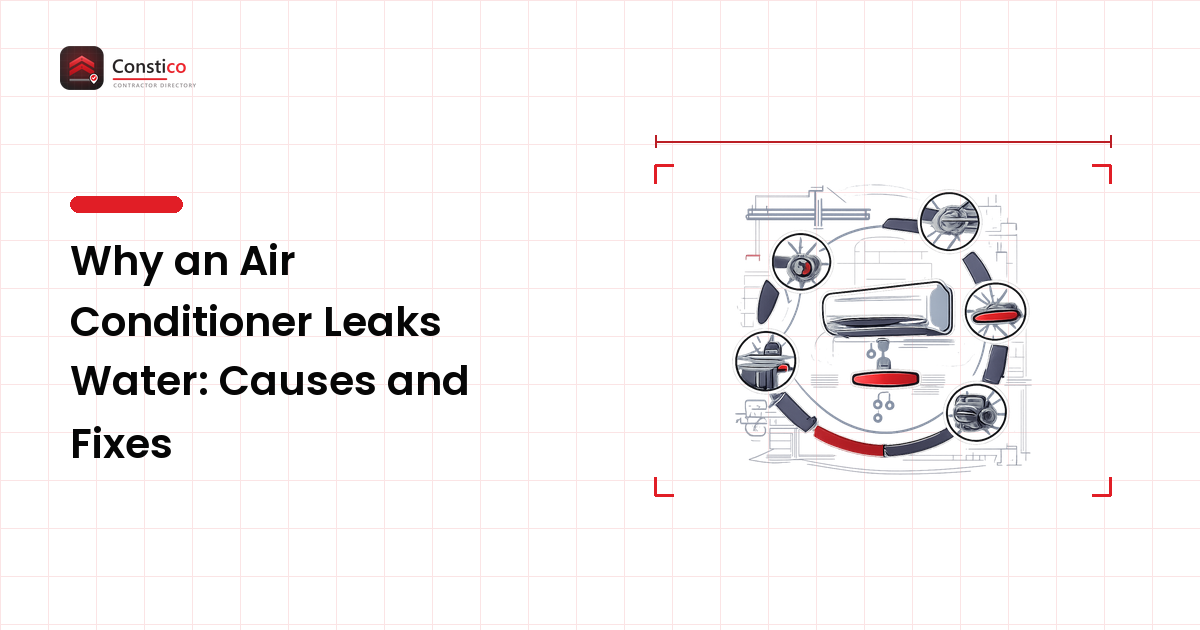
The takeaway up front: a healthy air conditioner is supposed to make water — that's condensation — and an indoor leak simply means that water isn't reaching the drain the way it should. Five causes account for nearly every case: a clogged condensate drain line, a frozen evaporator coil, a cracked or overflowing drain pan, a failed condensate pump, or a drain line that was never sloped correctly at installation. This guide walks through each one, what to check safely, and where the line sits between a five-minute fix and a job for a licensed technician.
Why a healthy air conditioner produces water at all
Water is a normal byproduct of cooling, not a sign of a fault. As warm, humid indoor air passes over the cold evaporator coil, moisture in that air condenses on the coil's surface — the same reason a cold glass sweats on a warm day. That condensation drips into a shallow drain pan beneath the coil and is carried away through a condensate drain line, usually to the outside or into a building drain. So water itself isn't the problem — the problem is water ending up inside the building instead of leaving through that drain path. Every cause below comes down to one of two things: the drain path is blocked or broken, or the coil is producing more water than the drain was designed to handle.
Safe checks before you call anyone
A few quick observations make any callout faster and cheaper:
- Cut power to the unit if water is dripping onto a socket, wiring, or a ceiling light.
- Check the filter for a thick coat of dust or lint — it's behind a large share of leaks, for reasons covered below.
- Look for ice on the indoor coil or refrigerant pipes, which points to a freezing problem rather than a simple blockage.
- Note exactly where the water appears — the front of the indoor unit, down a wall from a pipe, or under an outdoor condenser each point to a different cause.
None of this involves opening sealed components, handling refrigerant, or working on wiring — that's for a qualified technician.
Cause 1: A clogged or slow condensate drain line
This is the single most common reason an air conditioner leaks indoors. Every drop of condensation has to travel through a narrow drain line, and over months of continuous running that line collects fine dust, lint, and — in warm, damp conditions — a slimy algae or mould growth on its inner walls, narrowing it until it drains slowly or blocks outright.
When the line can't keep up, the drain pan fills and spills over, typically out of the front of the indoor unit and down the nearest wall. A blocked drain is the likely answer whenever the system is still cooling normally but leaking anyway. Clearing it properly means flushing the line and cleaning the pan; a competent technician will also check the pipe's slope, because a line that doesn't run steadily downhill will silt up again within months regardless of how well it's cleared.
Cause 2: A frozen evaporator coil
If you spotted ice during your check, this is very likely the cause. When the coil freezes into a block of ice and the system then cycles off — or the ice simply melts on its own — that meltwater arrives all at once, far faster than the drain can carry it away, and the excess leaks indoors. A frozen coil almost always traces back to one of two root causes.
Restricted airflow
A coil needs a steady flow of warm room air across it to stay above freezing. Starve that airflow — with a dust-clogged filter, a dirty coil, blocked return grilles, or closed supply vents — and the coil runs too cold and ices over. This is the direct link between a neglected filter and a puddle on the floor, and it's why the filter check matters most on this list. Clearing the restriction and letting the ice melt fully often resolves it without further work.
Low refrigerant charge
The other common driver is low refrigerant. When the gas charge drops below its design level, pressure in the coil falls, the coil runs colder than intended, and ice forms — which later melts into a leak. The honest point here: refrigerant is a closed, sealed charge and isn't consumed by normal operation, so a low charge always means a leak somewhere in the system. Topping up the gas without finding and sealing that leak buys a few weeks before the coil freezes again — a proper repair traces the leak first, then recharges.
Cause 3: A cracked, rusted, or overflowing drain pan
Sometimes the drain line is completely clear and the pan beneath the coil is the actual fault. A metal pan can rust through after years of standing water; a plastic one can crack with age or a knock during other work. Either way, water escapes before it reaches the drain outlet — and on some split systems, a pan or bracket that has shifted slightly out of level lets water spill over one edge instead. This cause is easy to misdiagnose: the drain gets flushed, the leak stops for a day, then returns, because the pan — not the line — was the real problem. A technician confirms it by watching where the water goes once the line is proven clear.
Cause 4: Condensate pump failure
Not every system drains by gravity. Where the indoor unit sits below the nearest suitable drain — common in basements, converted spaces, and many ducted or commercial installations — a small condensate pump lifts the water up and out. These pumps have a float switch and a motor, both of which fail over time: the float can jam or corrode, sediment can clog the intake, or the motor can wear out.
When the pump stops working, water backs up in its reservoir and overflows, usually with no warning beyond the puddle itself. Unlike a blocked drain line, this isn't something to flush your way through — the pump needs to be tested and, if faulty, replaced. Many pumps include a safety switch that shuts the system down when the reservoir is full, worth checking if the unit stops running along with the leak.
Cause 5: Improper installation slope or missing pipe insulation
Two installation-quality issues masquerade as later drainage faults. A condensate line without a consistent downhill slope pools water along its length and clogs far more often than a correctly pitched one — no amount of cleaning fixes a pipe that's level or slightly uphill in places; it needs re-running. And in humid conditions, bare or poorly insulated refrigerant pipes can sweat heavily, with condensation forming on the cold pipe and dripping at a joint or wall penetration — it looks like a drain leak, but the fix is re-insulating the pipework. Both are worth raising if a leak keeps recurring shortly after every service, since they point to the system's build rather than routine wear.
What happens if a water leak goes unaddressed
A slow drip is easy to wipe up and forget, which is why it tends to get ignored until it's expensive. Left alone, an indoor leak can stain and soften ceilings and drywall, feed mould inside a wall cavity, damage flooring and belongings, and — most seriously — reach electrical components or nearby outlets, turning a routine drain cleaning into a safety issue and a larger repair. Catching it while it's still just water is consistently the cheaper outcome.
What a proper fix actually involves
What it costs to resolve depends entirely on the cause, and any quote given before an inspection is a guess. Clearing a blocked line and cleaning the pan sits at the lower end; a dirty coil or a cracked pan is a step up; a failed condensate pump is a parts-and-labour job of its own; and sealing a refrigerant leak that's freezing the coil is typically the most involved repair, because the labour is in locating the leak rather than the gas itself.
A fair diagnosis follows the same order every time: confirm where the water is coming from, identify the root cause rather than the symptom, and lay out the repair options and their cost drivers before any work begins. Be cautious of anyone who reaches for "just flush the drain" or "just top up the gas" without explaining why the leak keeps returning.
When to shut it off and call a professional
Turn the system off and arrange a professional inspection promptly if water is reaching electrics or a ceiling light fixture, if there's visible ice on the coil or pipes, if a leak returns within a day or two of clearing the drain, or if a musty smell suggests mould in the pan or line. Cutting power stops further damage while you wait, and an early inspection almost always costs less than water left to soak into building materials and wiring over weeks.
FAQ
Why is my air conditioner leaking water inside the building?
Usually because condensation that should drain outside is escaping indoors instead — typically a clogged drain line, a melting frozen coil, an overflowing or cracked drain pan, or a failed condensate pump. Checking the filter and looking for ice narrows it down quickly.
Is it safe to keep running an AC that's leaking water?
If the water is only dripping into a tray or onto a floor away from any electrical component, running it briefly while you arrange a fix is fine. If it's reaching sockets, wiring, or a light fixture, switch it off at the breaker and get it inspected — that's a safety issue, not just a mess.
Can a dirty air filter really cause a water leak?
Yes. A clogged filter restricts airflow across the coil, the coil ices over, and the meltwater that follows overwhelms the drain line and overflows indoors — one of the most common and easiest-to-prevent causes on this list.
How do I stop the leak from coming back?
Keep filters clean on a schedule, have the condensate line, pan, and any pump checked during routine servicing, and make sure a frozen-coil or low-refrigerant issue is properly diagnosed rather than patched. Most drainage failures are caught during scheduled maintenance before they produce a visible leak.
Does a leaking AC mean the whole unit needs replacing?
Almost never. Water leaks are drainage or installation problems, not signs the compressor or the system has failed. Even a refrigerant leak is normally a repair — locate and seal it, then recharge — rather than a reason to replace the equipment.
Get the cause confirmed before you pay for a fix
A leaking air conditioner has a specific, findable cause — have it traced properly rather than guessed at with a drain flush or gas top-up every season. Compare licensed HVAC contractors and get quotes at constico.com so the diagnosis and the repair price hold up to scrutiny.