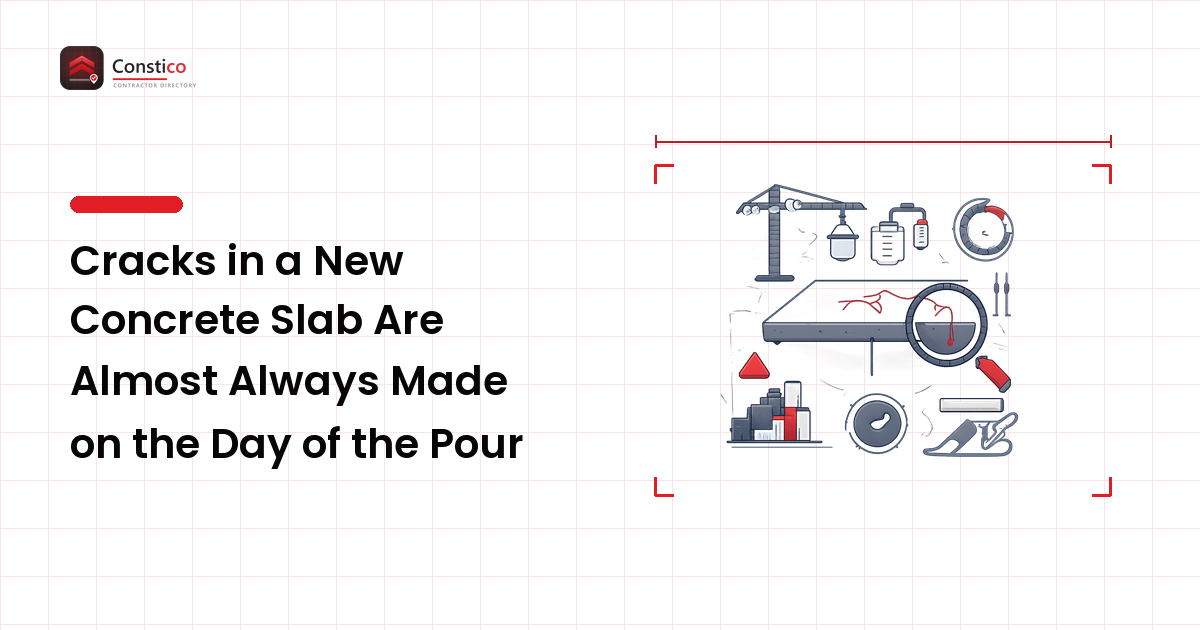
A slab looks perfect on the Monday and has a crack running across it by the Friday. The instinct is to assume something is structurally wrong, or that the concrete was bad.
Usually neither is true. Most cracks that appear in a new slab within days or weeks are shrinkage cracks, and shrinkage cracking is decided on the day of the pour — by how much water went into the mix, whether the joints were cut deep enough and soon enough, how the ground underneath was prepared, where the reinforcement ended up, and whether the surface was kept damp or left to dry in the sun. Concrete shrinks as it hardens. It is going to crack somewhere. The whole job of a good pour is to decide where.
That is also why these cracks are so frustrating: by the time you can see one, every decision that caused it was taken days earlier. Below is each mistake, why it is tempting on a real site, and the check that catches it while there is still time.
Anything structural — a raft, a suspended slab, a foundation, or a slab carrying loads — is an engineer's territory, not a rule of thumb's. Check specifications and local codes with a qualified professional before you rely on any general guidance.
First: is the crack serious, or just ugly?
Before diagnosing the pour, triage the crack. A rough sort:
- Usually cosmetic: fine, narrow cracks wandering across the surface; short cracks running from a corner or from around a drain or post; a map of shallow hairlines on a power-floated finish. These are shrinkage doing what shrinkage does.
- Worth a professional opinion: a crack where one side sits higher than the other; a crack that is visibly widening over weeks; one that runs the full depth at a free edge; one that leaks water into a space below; or any crack in a slab that carries structure.
The distinction between a cosmetic and a structural crack is the same reasoning used on walls, which our guide to telling cosmetic cracks from structural ones sets out in more detail. If the crack falls in the second group, stop reading and get it looked at.
Adding water at the truck to make the concrete easier to place
Why it is tempting: a stiff mix is hard, slow work. The crew has a large area to cover, the finishers want a wetter mix, and a hose is right there. Concrete placed wet spreads and levels almost by itself.
What it does: water beyond what the mix design allows is the most reliable way to cause shrinkage cracking. More water means more shrinkage as it leaves, a weaker surface, and more bleed water rising through the slab. The concrete that arrived correctly specified is not the concrete that ends up in the ground.
The cheap check: be present when the truck discharges and ask for the delivery ticket, which records the mix and usually any water added on site. Better still, settle it beforehand: who is allowed to add water, and how much?
The fix: if the mix is genuinely too stiff to place, the answer is an admixture that improves workability without adding water, ordered with the mix rather than improvised at the gate.
Cutting the control joints too late, too shallow, or too far apart
Control joints do not prevent cracking. They are pre-planned weak lines that decide where the crack goes, so it opens in a straight sawn groove instead of across the middle of your driveway.
Why it is tempting: the slab looks fine when the crew leaves. Cutting is a separate visit, joints break up a clean surface, and it is easy to defer to the next day.
What goes wrong: concrete does not wait. If it reaches its shrinkage limit before the joints are in, it makes its own joint, and no amount of cutting afterwards helps.
The checks that matter:
- Timing. Joints go in as soon as the slab is hard enough to saw without the edges ravelling — often within hours of finishing, and sooner in hot or windy weather.
- Depth. A widely used rule of thumb is around a quarter of the slab thickness. A joint scratched into the surface is decoration; it controls nothing.
- Spacing and layout. Panels should be roughly square rather than long ribbons, with joints carried through at re-entrant corners and around fixed points such as columns, drains, and post bases, which is where cracks otherwise start.
The fix: agree the joint layout on paper before the pour, and the cutting window as part of the price rather than as an afterthought. Confirm spacing against the mix, thickness, reinforcement, and local practice — the rule of thumb is a starting point, not a specification.
Pouring onto ground that was never properly prepared
Why it is tempting: the base is invisible ten minutes later, it is the least glamorous part of the job, and skipping compaction saves a day of plant hire.
What goes wrong: a slab needs uniform support. Soft spots, uncompacted backfill, rutted mud, a filled trench crossing the area, or a base that varies in thickness all let one part settle while the rest stays put. The slab spans the gap until it cannot, and the crack follows the soft spot — often exactly over an old trench.
The cheap check: walk the base before the pour. Heels should not sink. Look for tyre ruts, standing water, and changes in material, and ask whether fill was compacted in layers and where service trenches run.
The fix is the same discipline used under paving: excavate to a consistent depth, build up in compacted layers of the right material, and deal with drainage before anything is poured. Our guide to base preparation and compaction covers how those layers are built and why the compaction step is the one people skip.
Leaving the reinforcement lying on the ground
Why it is tempting: rolling the mesh out flat is quick, it looks correct from a distance, and everyone intends to hook it up as the pour progresses.
What goes wrong: mesh at the bottom of a slab, sitting on the sub-base, does close to nothing. It has to sit within the depth of the concrete to do its job, and pulling it up mid-pour with a hook rarely leaves it at a consistent height — it ends up wavy, back on the ground in places, and too close to the surface in others.
The cheap check: look at the mat before the concrete arrives, not during. Reinforcement should be sitting on purpose-made supports at regular spacing, at a consistent height, with laps and cover as specified.
The fix: insist that supports are in place before the truck is booked. This is a classic hold point — the kind of moment described in our guide to judging workmanship before it gets covered up, where two minutes of looking prevents a defect nobody can inspect afterwards.
Letting the surface dry instead of curing it
Curing is not drying. Curing is keeping moisture in the concrete while it gains strength, and it is probably the most misunderstood step on site.
Why it is tempting: the slab looks finished. The crew has moved on, the sun is out, and doing nothing feels like the natural next step.
What goes wrong: if water leaves the surface faster than the concrete can supply it — hot sun, dry wind, low humidity — the top skin shrinks against the mass below and tears while the slab is still plastic. Those cracks can appear within hours of finishing, and a slab left uncured over the following days also ends up weaker at the surface.
The cheap check: on the afternoon of the pour, ask what the curing method is and watch it happen. Covering, damp curing, or a sprayed curing compound are all legitimate. An empty slab in full sun is not a method.
The fix: plan around the weather — pour early in hot conditions, shelter the slab from wind, and have the curing materials on site before the concrete arrives.
Loading it before it has the strength
Why it is tempting: the slab is hard underfoot the next morning, the programme is tight, and the delivery of blocks has to go somewhere.
What goes wrong: concrete gains strength over time, and walking on it is not the same test as parking on it. Driving onto a new driveway, stacking heavy materials, or striking supports early can crack a slab that would have been fine a week later.
The cheap check: agree in writing when the slab may take foot traffic and when it may take vehicles — then keep it barriered until then.
What to do about a crack that is already there
If the triage above puts your crack in the cosmetic group, the honest answer is that it is permanent and mostly harmless. What matters is water.
- Outdoors, seal it. An open crack lets water in; water carries dirt, freezes in cold climates, and widens what it enters. A suitable flexible filler stops a crack becoming a repair.
- Indoors or under a finish, tell whoever is laying the floor above. Some finishes need the crack treated first, or an isolation layer, or it will telegraph through.
- Do not skim over a crack that is still moving. A cosmetic patch on a live crack simply cracks again, and hides the evidence of what it was doing.
- Photograph and date it, with a rule beside it. That is worth more than any description, whether you are monitoring it or raising it with the contractor.
FAQ
Do all concrete slabs crack eventually?
Concrete shrinks as it hardens, so the realistic goal is control rather than prevention: joints, a sound base, correctly placed reinforcement, and proper curing decide where cracks appear and how noticeable they are.
How soon do control joints need to be cut?
As soon as the slab can be sawn without the edges crumbling — typically the same day, and sooner in hot or windy weather. The window is short, and it closes whether or not the saw arrives.
Are fibres in the mix an alternative to joints?
No. Fibres help control the very fine cracking that happens while the concrete is still plastic. A slab with fibres and no joints will still crack where it wants to.
My new driveway cracked within a month. Can I raise it as a defect?
Raise it, with dated photographs. Whether it counts as a defect depends on what was specified and what the contract says about tolerances, so ask what mix was used, what joint spacing was intended, and how the slab was cured.
Does hot weather make concrete stronger because it sets faster?
It does the opposite. Rapid drying is the enemy of strength and the main cause of cracks appearing within hours of finishing, which is why hot-weather pours need shade, wind protection, and prompt curing.
Early cracking is not bad luck, and it is almost never bad concrete. It is water, joints, base, steel, curing, and patience — six decisions taken in a single day by people who will be somewhere else when the crack appears. Fix the decisions and you fix the cracks. For guidance on planning, inspecting, and running the work itself, visit ConstiCo.