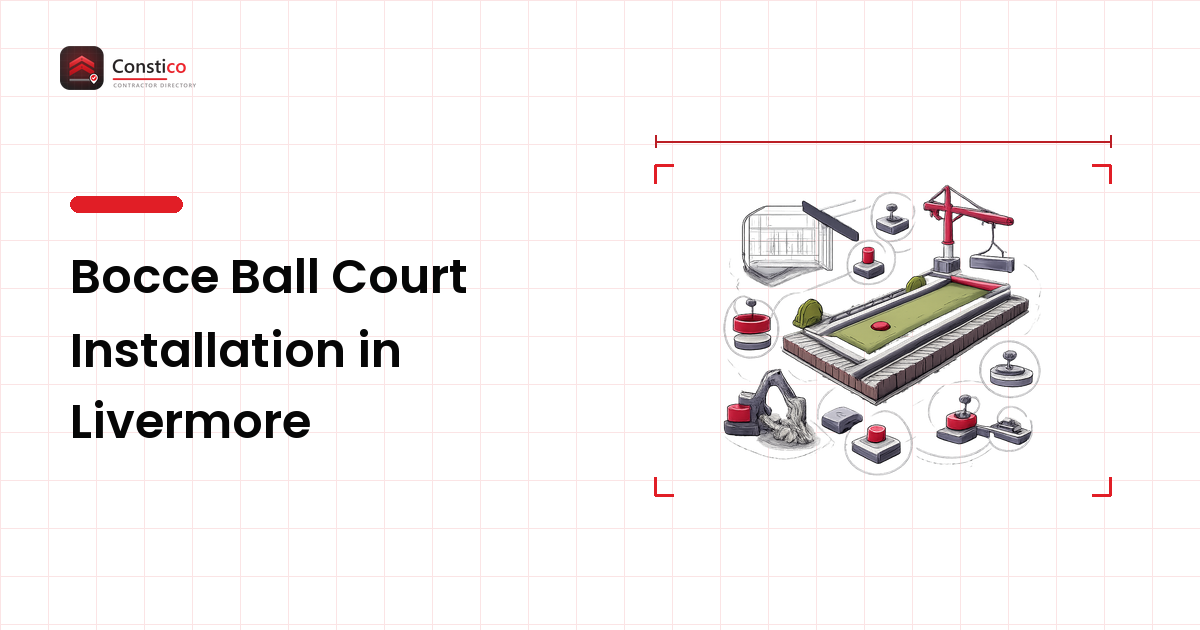
Bocce is one of the few sports where the playing surface is the entire game. A tennis court that is slightly out of level is still tennis. A bocce court with a low spot is a court where every ball drifts the same direction, and no amount of skill fixes it. That makes court installation a groundworks project first and a landscaping project second - which is exactly how anyone in construction should approach it.
Livermore is a good place to look at this properly. The city sits at the eastern edge of the Tri-Valley in the Livermore Valley wine region, where bocce has an obvious cultural home, and the soils here are demanding enough that a shortcut shows up fast.
Start with the ground, not the drawing
The Livermore valley floor carries a lot of expansive clay. It swells when it takes on water through the winter and shrinks back through the long dry summer. That seasonal movement is the single biggest threat to a flat playing surface, and it is why a court specification that works somewhere else can fail here.
A proper site assessment answers three questions before anyone draws a court:
- What is the soil? Expansive clay needs a deeper, better-compacted sub-base than free-draining sand or gravel. Practitioners here typically set sub-base depth in a range of roughly 4 to 18 inches depending on what the soil actually is, rather than applying one number everywhere.
- Where does water already go? Every yard already has a drainage pattern. A court is a large flat interruption to it. If you do not plan where the intercepted water goes, you have built a dam.
- What is the fall across the site? A court needs a level platform. On anything other than flat ground that platform has to be cut and filled into existence, which changes the scope considerably.
Sizing the court to the site
A standard bocce court runs about 60 to 90 feet long and 8 to 13 feet wide. That is the target, but it is not a requirement. Courts get built anywhere from about 30 feet by 5 feet up to 90 feet by 15 feet, and a shorter court plays a perfectly good social game.
The practical sizing constraint in most Livermore backyards is not the court itself but the space around it. You need room to stand at the throwing end, room to walk down one side, and ideally room to sit and watch. A 70-foot court crammed against two fences is a worse result than a 45-foot court with space to use it.
One layout detail worth knowing: the zone where the jack must come to rest is roughly 15 feet long, ending about 6 feet from the far end. If you shorten a court aggressively you are compressing that zone, which changes how the game plays. It is a trade-off to make deliberately.
The layers that matter
A court is built up in layers, and each one has a job.
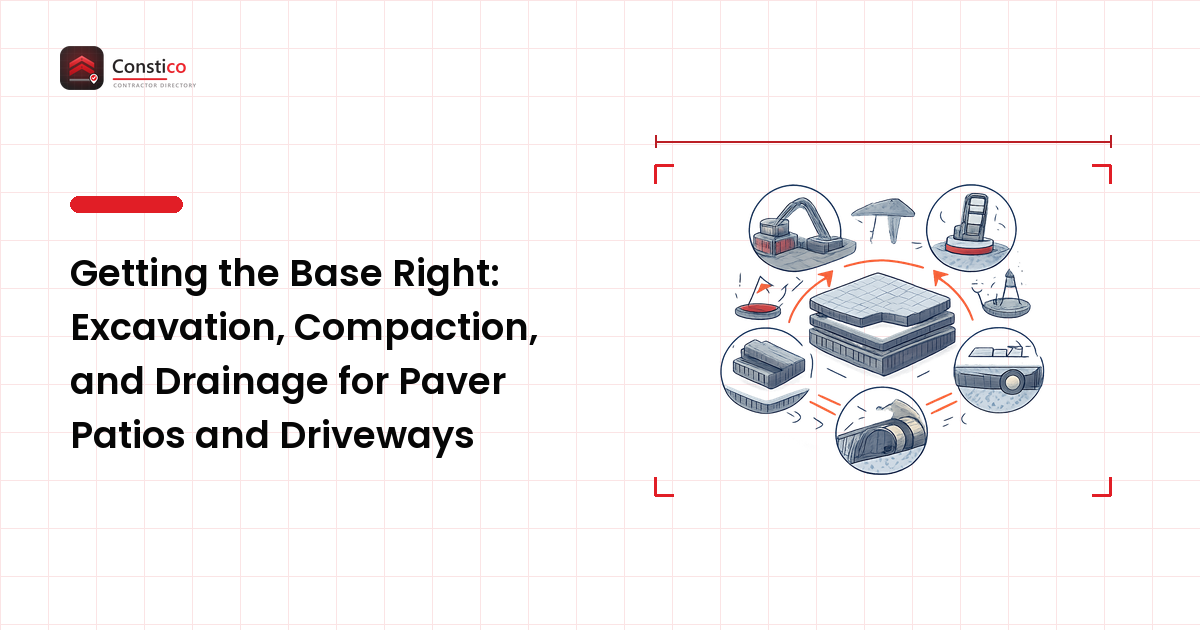
- Excavation and sub-base. Cut out to depth and bring the sub-base up in compacted lifts. On Livermore clay this is the layer that absorbs seasonal movement. Skimp here and everything above it telegraphs the ground's behaviour.
- Drain rock and decomposed granite. A typical build puts down a 3 to 4 inch combination of 3/4 inch crushed drain rock and decomposed granite, compacted with a plate compactor until it is flat and tight. The drain rock is what carries water sideways and out instead of letting it sit under the playing surface.
- The border. Concrete curbs or pressure-treated wooden boards roughly 4 to 12 inches high, set true and square. The border is structural - it holds the surface material in - and it is also part of the game, because balls bank off it.
- The playing surface. Crushed oyster shell, decomposed granite, gold fines, or synthetic turf. A fine 30 mesh sand dressing is used to give loose surfaces a smooth, fast, consistent roll.
There is also a permeable-base route worth knowing about for sites with real drainage pressure. Pervious concrete typically runs at something like 15 to 25 percent voids, with water flow rates around 480 inches per hour - numbers that let a court double as a drainage asset rather than an obstacle.
Choosing a surface
Each surface trades differently:
- Crushed oyster shell is the traditional choice. It is light in colour, packs down well, and gives the quick, true roll that experienced players want. It needs occasional raking and topping up.
- Decomposed granite and gold fines sit firmer and read as part of a landscape rather than as a sports surface. Popular where the court has to look like it belongs in the garden.
- Synthetic turf is the low-maintenance option. It plays a little slower, but it does not need raking, and it copes with a court that doubles as general family space.
Sequence and duration
The build itself is usually about one to two weeks on site, with the variation coming almost entirely from site preparation. A flat, accessible backyard on decent soil is at the short end. A sloping lot needing cut, fill and retaining, or a site where the machinery has to come through a narrow side return, is at the long end.
The order rarely changes: assess and set out, excavate, sub-base, drainage, drain rock and DG, border, surface, dress, clean up. What changes is how long stage two and three take.
Common failure points
If you are inspecting or specifying a court, these are the things that go wrong:
- Under-compacted sub-base. Shows up as dips within the first couple of wet seasons.
- No drainage plan. Water either sits on the court or gets pushed at a structure.
- Border set out of level. The frame is the reference for the whole surface; if it is out, the surface is out.
- Surface laid too thick or too thin. Both change the roll, and neither is fixable without lifting material.
For a broader view of how to inspect construction work before you sign it off, our building inspection guide covers the general principles.
Who builds bocce courts in the Bay Area
If you would rather not project-manage this yourself, it is a specialist trade and there are Bay Area crews that do only this kind of work.
Pavers and Turf by O'Neill's has installed bocce courts across the Bay Area from its Livermore base since 2005, and its bocce ball courts page sets out the full specification it builds to: court sizes from 30 ft x 5 ft up to 90 ft x 15 ft, a sub-base of 4-18 inches depending on the soil, a 3-4 inch layer of 3/4 inch crushed drain rock and decomposed granite compacted flat, a fine 30 mesh sand dressing, borders in concrete or pressure-treated board around 4-12 inches high, and a choice of crushed oyster shell, decomposed granite, gold fines or synthetic turf on top. Typical installs run about one to two weeks on site. As with any contractor, get more than one quote and ask to see courts they have actually built.
Their city pages go into the local detail:
- Bocce Ball Court Installation in Livermore
- Bocce Ball Court Installation in Pleasanton
- Bocce Ball Court Installation in Dublin
- Bocce Ball Court Installation in Danville
Contact details
Pavers and Turf by O'Neill's 2133 Research Dr Unit 16, Livermore, CA 94550 Phone: (925) 443-7888 Email: [email protected] Hours: Monday to Friday 8am-5pm; Saturday and Sunday closed
- Website: https://paversandturf.com/
- Bocce ball courts: https://paversandturf.com/bocce-ball-courts/
- About O'Neill's Green Services: https://paversandturf.com/about-oneills-green-services/
- Contact us: https://paversandturf.com/contact-us/
- Project gallery: https://paversandturf.com/projects/
- Past installs: https://paversandturf.com/galleries/
- Blog: https://paversandturf.com/blog/
- Instagram: https://www.instagram.com/paversandturfbyoneills/
- Facebook: https://www.facebook.com/PaversandTurfbyOneills
- LinkedIn: https://www.linkedin.com/in/mike-o-neill/
- Google Business Profile: https://maps.app.goo.gl/5GUXa8cJNBQRSK3M8