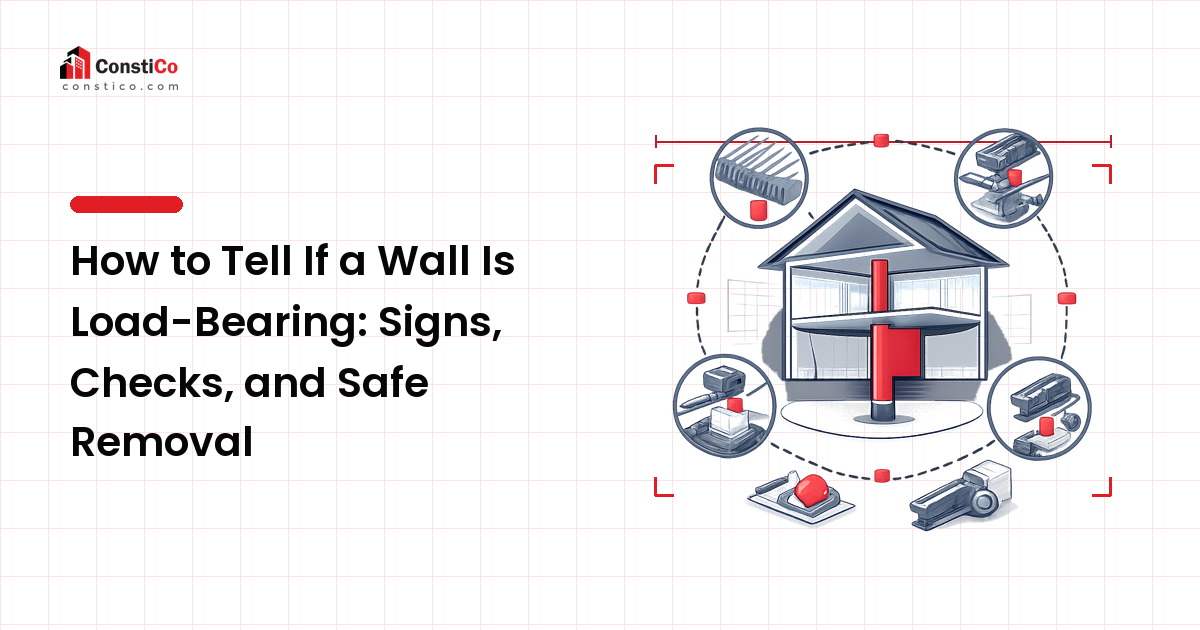
You want to open up a kitchen, lose a narrow hallway, or knock two bedrooms into one — and it hinges on one question: is that wall holding up the house? Get it wrong and you risk more than a sagging ceiling: cracked walls on the floor above, doors that jam, an unsafe structure. So here's the honest starting point: you can narrow it down confidently from a handful of reliable signs, but you cannot safely confirm a wall is non-load-bearing from looks alone — a structural engineer signs that off before anything comes out.
This guide gives you the signs that matter, a repeatable way to check them, the traps that fool people, and what safe removal involves.
What "load-bearing" actually means
A load-bearing wall carries weight from above — roof, floors, and other walls — and passes it down through a continuous path to the foundation. Take it away without replacing that support and the load has nowhere to go but down.
A non-load-bearing wall, or partition, only divides space — it holds up its own weight and little else. Remove it and the structure above doesn't notice.
There's a subtlety worth knowing before you pick up a crowbar: a wall can be structurally important without carrying much vertical load. Braced or shear walls resist sideways forces from wind and, in some regions, earthquakes, so an interior wall might carry little floor load yet still be a bracing line that keeps the building rigid. That's why visual signs get you to "probably," not "certainly" — and why sign-off belongs to an engineer who can read the whole load path.
Five signs a wall is probably load-bearing
No single clue is proof. The confidence comes from several pointing the same way.
- The joists run across it. Look at the floor or ceiling joists above the wall (from the basement, crawlspace, or attic). If they run perpendicular to the wall — crossing over it, or ending and lapping on top of it — the wall is very likely supporting them. Joists lapped directly above a wall are a strong tell: they're joined there because something underneath holds them up.
- Something supports it from below. A bearing wall usually sits above a beam, a row of posts, another wall, or a thickened footing. Dedicated support directly beneath means the wall is almost certainly carrying load to it.
- It stacks. Loads travel in straight vertical lines, so a wall that lines up with a wall or beam above and a support below sits in a continuous load path — classic load-bearing. Clear space above and nothing special below makes it far less likely to be structural.
- It's an exterior wall. Almost all exterior walls are load-bearing: they carry roof and floor loads and usually act as bracing too. Treat any external wall as structural until an engineer says otherwise.
- There's a beam or header over its openings. A substantial header spanning a doorway suggests the wall is designed to carry load across that gap; a flimsy lintel or none points the other way.
Signs a wall is probably just a partition
The reverse pattern suggests a non-structural wall — but read these as "worth a closer look," not a green light.
- Joists run parallel to it. If the joists above run in the same direction as the wall rather than across it, it generally isn't carrying them.
- Nothing supports it below. It sits on the slab or on joists with no beam, post, or footing beneath.
- It doesn't stack. No load lands on it from above, and it carries nothing down to a support.
- It's a short wall carving up a room. Stub walls and closet partitions added to subdivide space are often non-structural — though "often" is not "always."
Two traps catch people here. First, modern engineered roofs and floors change the answer: a clear-span trussed roof transfers its weight straight to the exterior walls, which can leave the interior walls beneath it as pure partitions, and engineered floor trusses and I-joists span farther too. Second, a wall full of pipes or ducts is not automatically load-bearing — services get routed through whichever wall is convenient, structural or not. They complicate removal, but they don't decide the structural question.
How to check, step by step
Work through this in order; each step raises or lowers your confidence.
- Find the joists and note their direction. From the basement, crawlspace, or attic, see which way the joists run relative to the wall. Perpendicular leans load-bearing; parallel leans partition.
- Trace the load path. Look for a beam, post, or footing lined up under the wall, and check whether a wall or concentrated load stacks directly above it. A continuous vertical path signals a bearing wall.
- Read the drawings and framing. Original structural sheets (often labelled "S") settle it fastest — bearing walls, beams, and posts are called out there. Factor in the roof and floor system too: a clear-span trussed roof or long-spanning engineered floor can leave an interior wall non-structural.
- When signs conflict or you're unsure, get it confirmed. A structural engineer — the same specialist our building inspection guide describes for structural sign-off — can read the whole load path and give a definitive answer plus a safe design.
Load-bearing vs partition wall: quick comparison
| What to check | Likely load-bearing | Likely partition |
|---|---|---|
| Joists above | Run perpendicular; lap over the wall | Run parallel to it |
| Support below | Beam, post, or footing under it | Nothing special beneath |
| Stacking | Load above and support below | No load above or support below |
| Location | Exterior or central spine wall | Short wall subdividing a room |
| Over openings | Substantial header or beam | Light lintel or none |
The pattern beats any single row — a wall can tick one "partition" box and still be structural.
Your field checklist before you touch a wall
- [ ] Located the joists and noted whether they run across or along the wall
- [ ] Checked below for a beam, post, or footing under the wall's line
- [ ] Checked whether a wall or load stacks directly above
- [ ] Confirmed whether it's an exterior wall (assume load-bearing)
- [ ] Looked for a header or beam over any opening in the wall
- [ ] Found the original structural drawings, if they exist
- [ ] Considered the roof and floor system (clear-span trusses shift the answer)
- [ ] Booked a structural engineer to confirm — before anything is removed
Can't tick the last box with confidence in the ones above it? You're not ready to demolish.
What removing a load-bearing wall really involves
Confirming a wall is load-bearing doesn't mean it can't come out — it means you replace its job with something engineered to do the same work. Expect:
- A properly sized beam. An engineer specifies a beam — engineered timber such as LVL or glulam, or steel — sized to the span and the load it must carry.
- Posts and a load path to the foundation. The beam's ends need posts that carry the load down to adequate footings. If the existing footings can't take the point loads, that work gets added.
- Temporary support during the work. Shoring holds up the structure while the new beam goes in; skipping it is where serious damage — and danger — happens.
- A permit and, almost always, engineered calculations. Altering structure typically requires a building permit and an engineer's design. Rules vary by jurisdiction, so confirm what your local building authority requires before you start.
Cost tracks the engineering, not the demolition: a simple single-storey opening is far cheaper than a wide span carrying two floors and a roof, where beams get large and new footings may be needed. Get the engineer's design first, then quote from it.
Frequently asked questions
Can I tell if a wall is load-bearing without opening it up?
Often you can get to "probably": check joist direction, what supports the wall below, whether load stacks above it, and the original drawings. What you can't do is confirm it's safe to remove from those clues alone — braced walls and hidden load paths mean final sign-off belongs to a structural engineer.
Are all exterior walls load-bearing?
Nearly all are. Exterior walls carry roof and floor loads and usually provide bracing against wind, so treat every external wall as structural unless an engineer confirms otherwise. The interesting question is almost always about the interior walls.
How do I know which way my joists run?
Look from the basement, crawlspace, or attic where the framing is exposed, and note the direction the joists travel relative to the wall. Perpendicular joists — crossing or lapping over it — point to load-bearing; parallel joists point toward a partition.
Is a wall load-bearing just because it has pipes or wires in it?
No. Plumbing, ducts, and wiring are routed through whichever wall is convenient, structural or not. Services make removal more involved, but they don't answer the structural question — judge that on joists, support, and load path instead.
Do I need a permit to remove a load-bearing wall?
In most places, yes — altering structure typically requires a building permit and an engineer-designed beam and supports. Requirements vary by jurisdiction, so check with your local building authority before work begins, not after.
Next step
Before you open up a space, work the wall methodically: read the joists, trace the load path up and down, check the drawings, then decide. If the signs point to load-bearing — or disagree — don't gamble on a hunch. Get a structural engineer to confirm the wall's role and design the beam and supports that replace it, then build to a permit. Identifying the wall correctly is the cheap step that protects everything above it. For an expert eye on your structure before you start, begin at constico.com.